The Industry Operations Investigator shows up unannounced on a Tuesday and asks to see your bound book. Three hours later she is pointing at a Form 4473 with a blank in box 21 and asking, in a friendly voice, whether you knew that field was required. You say something honest and casual. No recorder is running. She writes down a version of it, and that version is now the single most dangerous sentence in your file.
This is the shape of a routine Federal Firearms License compliance inspection in 2026. It does not feel adversarial, and it usually is not meant to be. But the paperwork it produces is measured against a legal standard that most licensees never think about until it is too late: willfulness. And the evidence that satisfies that standard is not the blank box. It is what you said about the blank box.
The Interview That Becomes The Record
An ATF compliance inspection is not a raid. It is a records audit with an interview attached. The Industry Operations Investigator reviews your Acquisition and Disposition book, pulls a sample of ATF Form 4473 transaction records, and walks you through every discrepancy she finds. Missing signatures. Late entries. A transfer with no NICS check documented. A trace request that took you three weeks to answer.
At each one she asks what happened and whether you understood the requirement. None of it is recorded. She takes handwritten notes, then later drafts a narrative and, if warranted, a Report of Violations on ATF Form 5030.5. That narrative is what the Area Supervisor, the Director of Industry Operations, and any future revocation hearing will read.
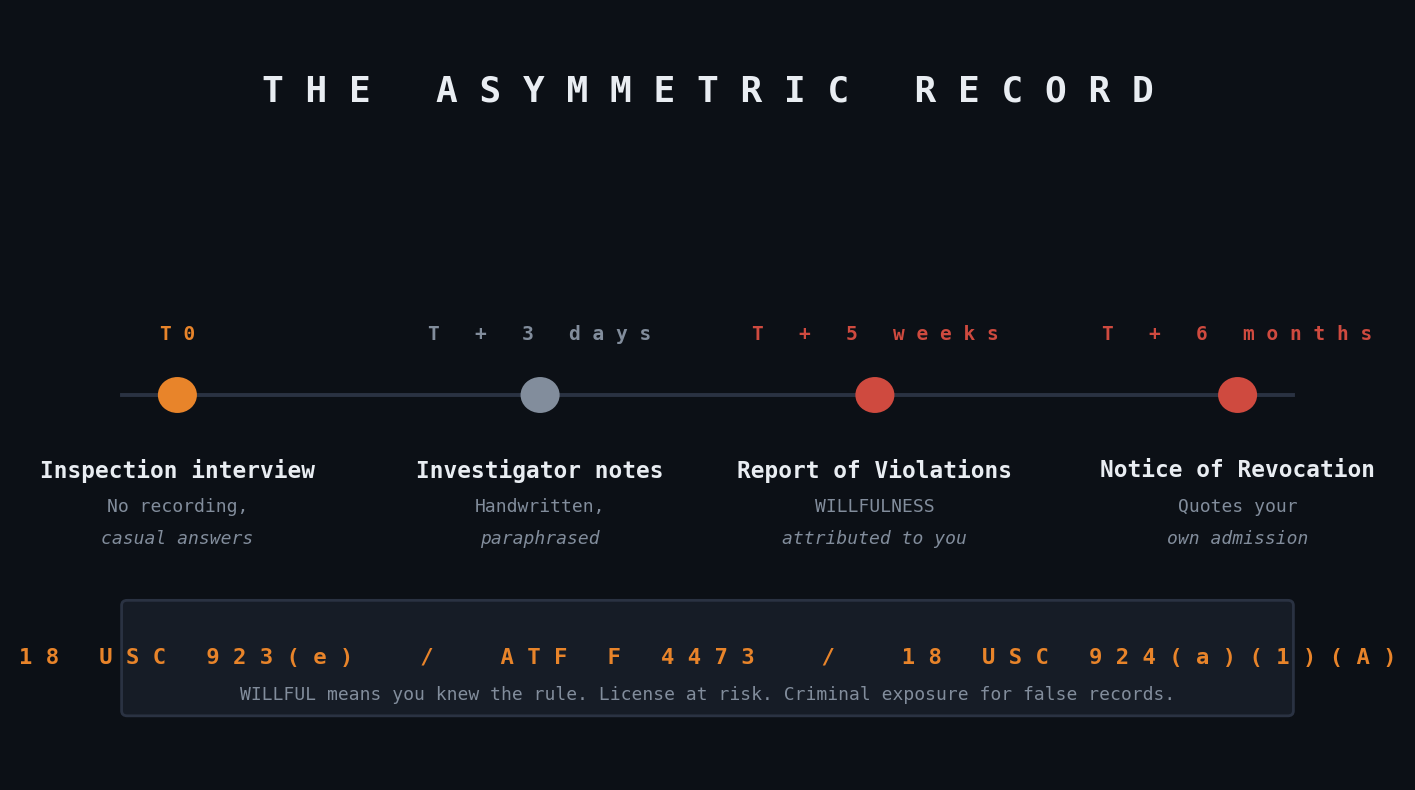
Under 18 USC 923(e), ATF can revoke a license only for violations that are willful. Willfulness, in this context, does not require bad intent or a plan to break the law. It means you knew the legal requirement and disregarded it, or acted with plain indifference to a known duty. Your casual answer about whether you knew the rule is the exact evidence that proves it. The technical error opens the door; your own words walk the government through it.
Why 'It Was An Honest Mistake' Does Not Survive
Truth is not what gets tested at the hearing. Willfulness is. A blank box on a 4473 is a technical violation. A blank box plus a documented statement that you knew the box was required turns that same violation into grounds for revocation.
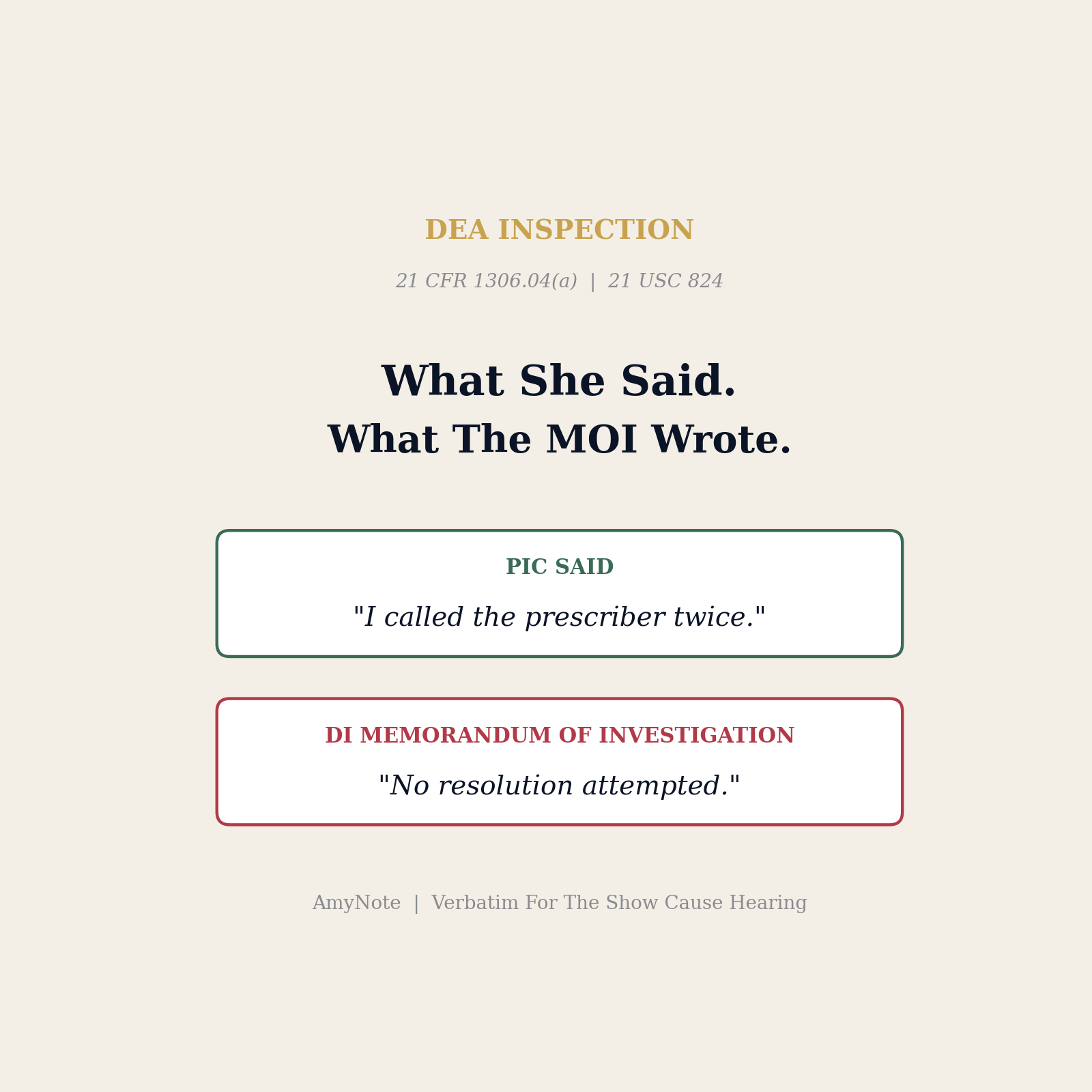
The investigator is not trying to trap you. She is doing her job, and her notes are her honest recollection. But her paraphrase of "I know I'm supposed to, I just get slammed on Saturdays" becomes "licensee acknowledged awareness of the requirement." Same event, very different weight. The first is a harried retailer describing a workflow problem. The second is a signed admission that satisfies a statutory element.
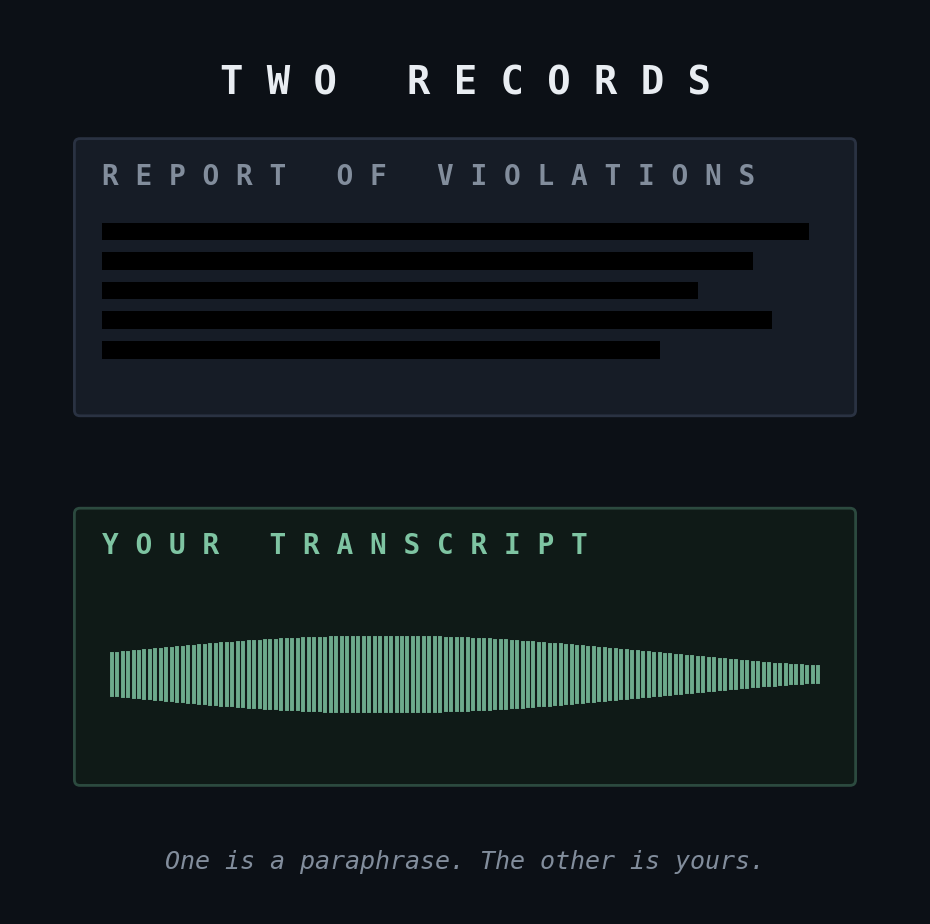
Your point-of-sale system logs the sale. Your 4473 binder holds the forms. Neither one captures the closing conference, the questions she asked, or the qualifiers you attached to every answer. When the Notice of Revocation cites your own admission months later, there is no primary source to check it against. The Report of Violations is the record, and a paraphrase written from memory is not a neutral document — it is compressed, and compression favors whoever is holding the pen.
There is a second, sharper exposure hiding underneath the revocation risk. 18 USC 924(a)(1)(A) makes it a federal crime to knowingly make a false statement or representation in the records a licensee is required to keep. If the investigator's narrative frames a late or reconstructed bound-book entry as a knowing falsification rather than a bookkeeping lag, the same interview that threatens your license can seed a criminal referral. The distinction between "I fell behind" and "I knew it was wrong and entered it anyway" is entirely a matter of how your words were captured.
What Actually Works
The only durable protection is a contemporaneous audio record of the inspection interview itself, transcribed within minutes and stored on hardware you control. Not a covert recording. A recording made openly, with consent stated at the top, kept as your own working file the way any licensee keeps notes of a federal inspection. Recording an IOI is not obstruction; it is documentation, the same instinct that makes you photograph a delivery or keep the FedEx receipt on a firearm shipment.
AmyNote runs the entire capture on your phone — the one device that is already in your pocket at the counter when the investigator walks in, with no laptop to set up and no hardware to charge. Audio is processed through the OpenAI Speech API for transcription with speaker diarization, then Anthropic Claude Opus summarizes the exchange, pulls out every question-and-answer pair, and flags any hedged or qualified statement so nothing gets flattened in paraphrase. The full transcript sits in your local vault with end-to-end encryption. Nothing lands on a shared drive, nothing routes through a vendor cloud waiting for a subpoena.
Both OpenAI and Anthropic contractually guarantee zero training on user data. Audio is encrypted in transit and not retained after processing. Transcripts are stored locally on device with end-to-end encryption. The record you build is a business record you own, not a file sitting on someone else's server.
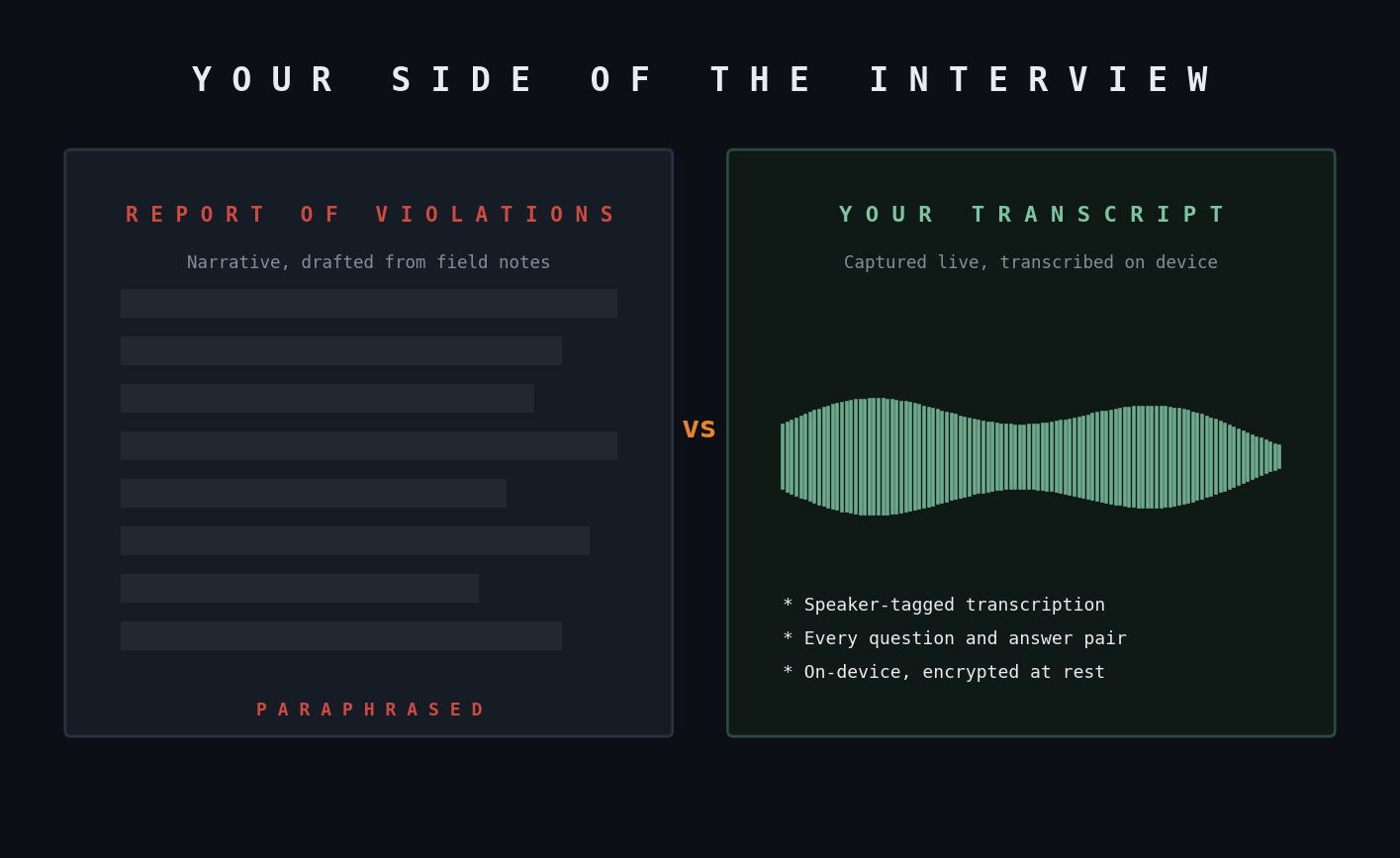
Six weeks later, when the Report of Violations quotes you as acknowledging you knew the requirement, you can pull up the actual exchange. The transcript shows you said the clerk who ran that sale was new and you had already scheduled a retraining before the inspection. That single clause is the difference between a willful violation that ends your license and a corrected error that ends in a warning letter.
The Documentation Pattern That Holds Up
A defensible inspection-interview workflow has four properties, and none of them depend on outrunning the investigator or refusing to answer.
- The licensee owns the audio. The recording is captured on your own device, in your own place of business, with consent stated openly at the start. It never sits on a government drive and never depends on a discovery request to retrieve.
- The record is contemporaneous. It exists the day of the inspection, transcribed within minutes — not reconstructed from memory after the Report of Violations arrives. Recency is the whole point, because the government's narrative will be drafted against the investigator's notes, not against your best later recollection.
- Every hedge is preserved. The qualifiers you attach to an answer — "that clerk was new," "I'd already scheduled retraining," "I was mid-way through fixing the book" — are exactly the words a paraphrase drops. A verbatim transcript keeps them, and they are what separate a corrected error from a willful one.
- The response is grounded. When the 5030.5 arrives, your written response cites the transcript by timestamp, not by "the licensee recalls." A rebuttal anchored to a recording made the same day carries weight that a memory nine months later never will.
Licensees who adopt this pattern do not avoid inspections, and they do not turn a friendly IOI into an adversary. What they eliminate is the one category of revocation that turns entirely on the gap between what the investigator wrote and what the licensee actually said — the gap that quietly converts a paperwork error into the willfulness element.
Getting Started
Install AmyNote on a personal device before your next scheduled or surprise inspection. Record every compliance inspection interview, every closing conference, and every warning conference with your Area Supervisor. State consent openly at the start and note the timestamp in your own file. When the Report of Violations arrives, compare it against your transcript the same week and file a written response if the wording drifts. Your Federal Firearms License is worth the fifteen minutes it takes to set up, and the willfulness element is worth never conceding by accident.
Originally published as an X Article by @AmyNoteApp.