Two special agents came to your kitchen table at 9:47 AM. They said they wanted to ask a few questions about a matter that "may or may not" involve you. You agreed. You had nothing to hide. Two hours later they left. Three weeks after that your attorney is looking at a six-page FD-302 that quotes a "yes" you are almost certain you never actually said.
This is the shape of a voluntary, non-custodial FBI interview in 2026. There was no court reporter. There was no recording. There is one government document that summarizes what happened, and that document becomes the version of the conversation that everyone downstream — prosecutors, grand jurors, appellate judges — will read. Your version, if you did not build one within the hour, is memory.
The Interview That Was Not A Transcript
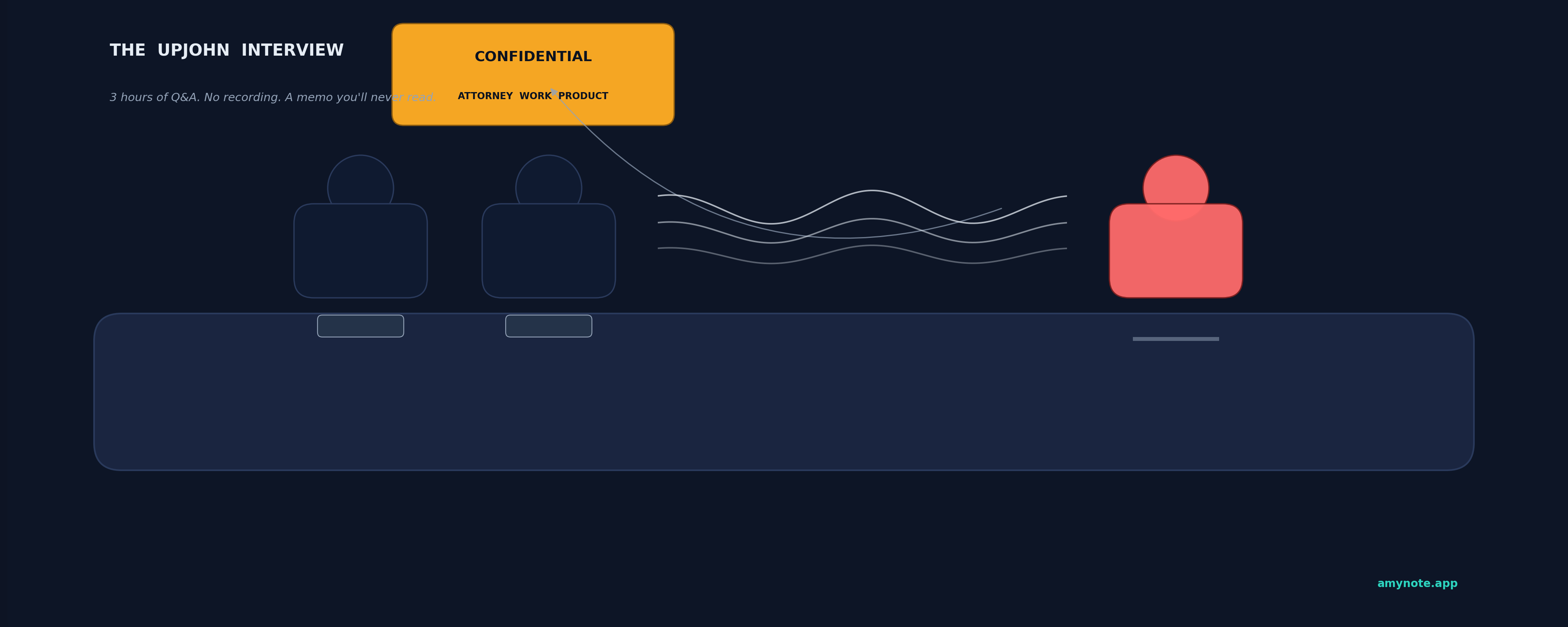
The FBI does not record voluntary interviews by default. A case agent asks the questions and takes notes on a legal pad or a laptop. A second agent sits across from you as the corroborating witness. Nobody hits record. When the interview ends, both agents leave, and the case agent writes up what happened later, often days later, from those notes and from working memory.
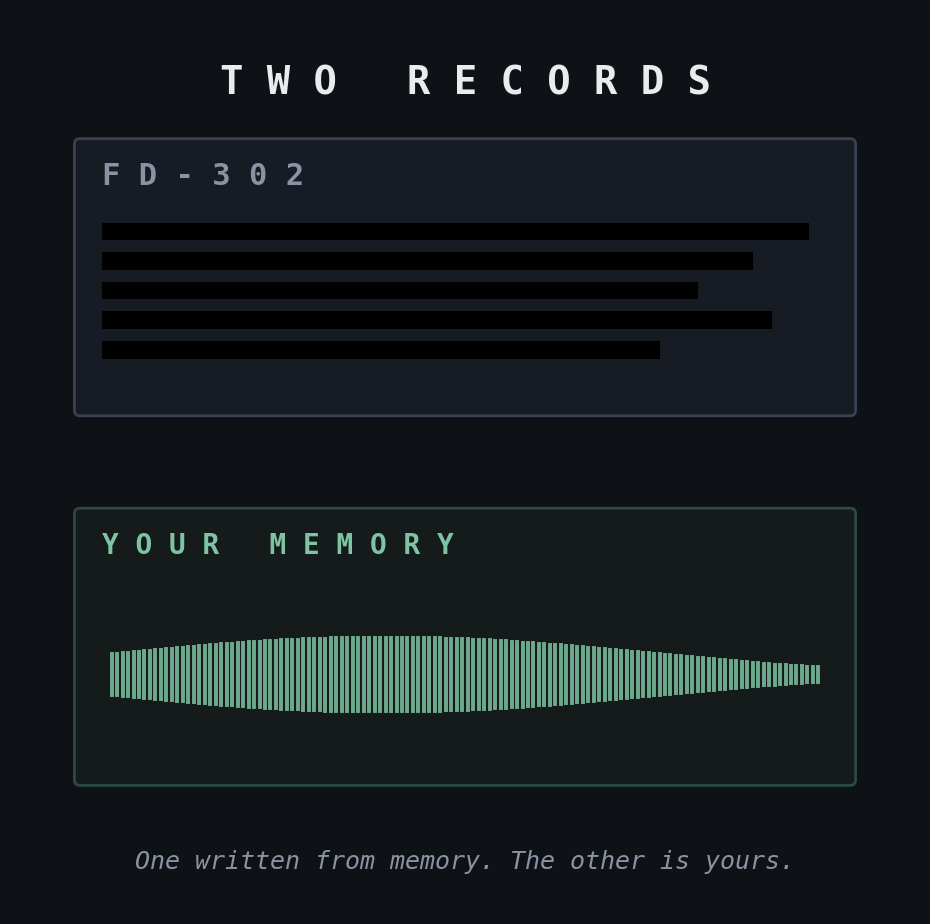
That write-up is the FD-302. It is not a transcript. It is a narrative summary in the third person that compresses two hours of conversation into six pages of "SUBJECT stated that." Once it is signed by the case agent and reviewed by the co-agent, that document becomes the government's record of what you said.
You are not entitled to a copy. You will not see it until charges or discovery. There is no side-by-side recording to compare it against, because nobody ever pressed record. And by the time your defense counsel is finally allowed to read it, the interview itself is a memory that is eight, nine, or twelve months old.
Why 'I Just Told The Truth' Is Not A Defense
Truth is not the standard the 302 is measured against. Consistency is. If the agent's 302 says you affirmed a specific date, a specific meeting, a specific dollar figure, and your later account differs, that gap alone is chargeable under 18 USC 1001, false statements to a federal agent. Five years per count. Each material misstatement or omission is its own count.
The list of people who learned this the hard way is long and public. Truthful witnesses have been prosecuted because their later recollection did not match what a case agent wrote down from memory three days after a conversation. You do not need to have lied. You only need to look, in retrospect, like you did. And the retrospective view is anchored to the 302, not to the audio, because no audio exists.
The Structural Advantage The Government Enjoys
The compression that produces an FD-302 is not neutral. It runs through three filters, each of which favors the government's case theory. First is the case agent's hearing and typing speed during the interview itself. Nobody can capture two hours of conversation on a legal pad. Second is the rewrite into the 302 narrative structure, drafted days later against the case theory the agent already has in mind. Third is the supervisor review before the document moves to the U.S. Attorney's Office.
Each pass shortens the record. Each pass hardens the conclusions. Conditional language collapses: "I think I met with him maybe twice, could have been three times" becomes "SUBJECT stated he met with X on approximately three occasions." Sequence flattens. Hedges disappear. Words the subject never used — "admitted," "acknowledged," "conceded" — get added by inference.
What Actually Works
The counterintuitive fix is to create your own contemporaneous record, immediately, before the 302 exists. Not the interview itself. The debrief.
The best-practice sequence for anyone who has just been interviewed:
- Call your attorney within the hour, not tomorrow.
- Sit down together in a private room. Recorder on.
- Walk chronologically from the doorbell to the goodbye handshake.
- Reconstruct every question, every answer, every pause, every specific date, name, and dollar figure you were pressed on.
- Note who asked what, and which agent was writing.
- Flag every place you hedged, corrected mid-sentence, or asked the agents to clarify their question.
AmyNote is built for exactly this kind of debrief. It captures the audio, produces a dual-model transcript using OpenAI's Speech API for high-accuracy multi-speaker transcription and Anthropic Claude Opus for the structured chronology, tags speakers, and keeps the full record on your device. Cross-session speaker identification means the app remembers your attorney's voice from meeting to meeting, so subsequent interview prep and post-interview debriefs share a single searchable archive.
Both OpenAI and Anthropic contractually guarantee zero training on user data. Audio is encrypted in transit and not retained after processing. Transcripts are stored locally on device with end-to-end encryption. The debrief file never leaves your control, and never enters a training corpus.
When the 302 finally arrives, your defense counsel is not reconstructing your memory of a two-hour interview from three weeks ago. They are opening a timestamped, speaker-tagged transcript recorded within the hour it happened. That is your side of the transcript.
The Documentation Pattern That Holds Up
A defensible subject-interview workflow has four properties.
- The subject owns the debrief audio. The recording is captured on the subject's device inside a privileged setting — typically a private conference room with counsel present. It never sits on a government drive and never depends on discovery for retrieval.
- The debrief is contemporaneous. It is generated within the hour the interview ends, not the following day. Recency matters: recall accuracy degrades sharply after the first evening's sleep, and the 302 will be drafted against the agent's notes, not against your best memory.
- The record is grounded. When the 302 arrives, every rebuttal in the defense response cites the debrief transcript by minute and second. There is no "the client recalls" — there is only "the client said, at 12:47 of the debrief, that."
- The privacy posture matches the discovery posture. Zero-training contracts, encrypted transport, on-device storage. The debrief is a defense document, covered by the attorney-client privilege and the work-product doctrine, and it should be created and stored in a way that never waives that protection.
Subjects who adopt this pattern do not eliminate FBI investigations. They eliminate the specific category of prosecution that turns on the gap between the agent's typed 302 and what the subject actually said. That is the category that turns a witness into a defendant.
Getting Started
If you have a voluntary interview on the calendar with any federal agent, do not sit for it without counsel. If you already did, the window to build a defensible record is measured in hours, not days. Call your attorney, book a debrief for the same afternoon, and capture it with AmyNote before the 302 is even a draft. The government will have one narrative. You need to have yours.
Originally published as an X Article by @AmyNoteApp.