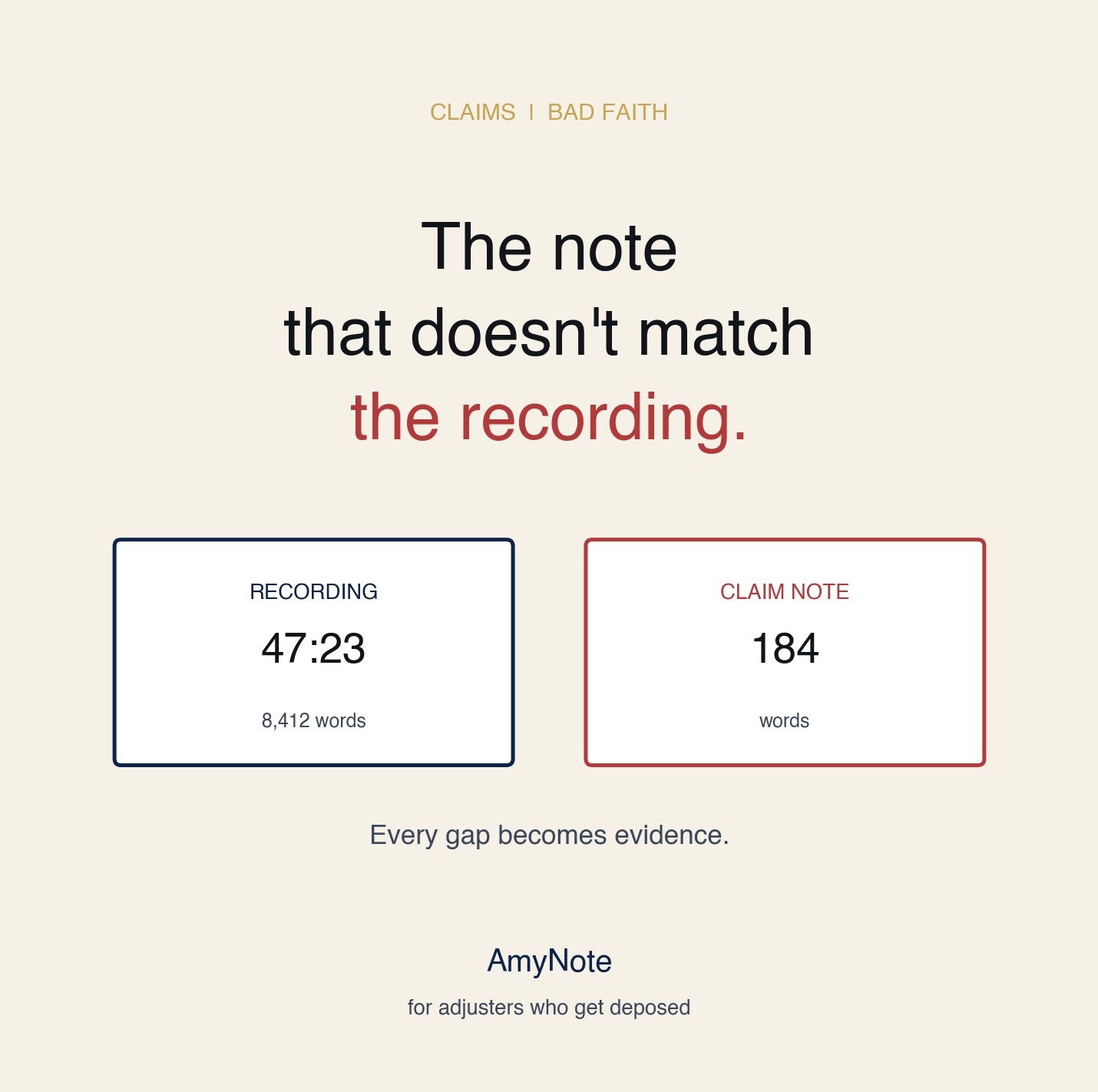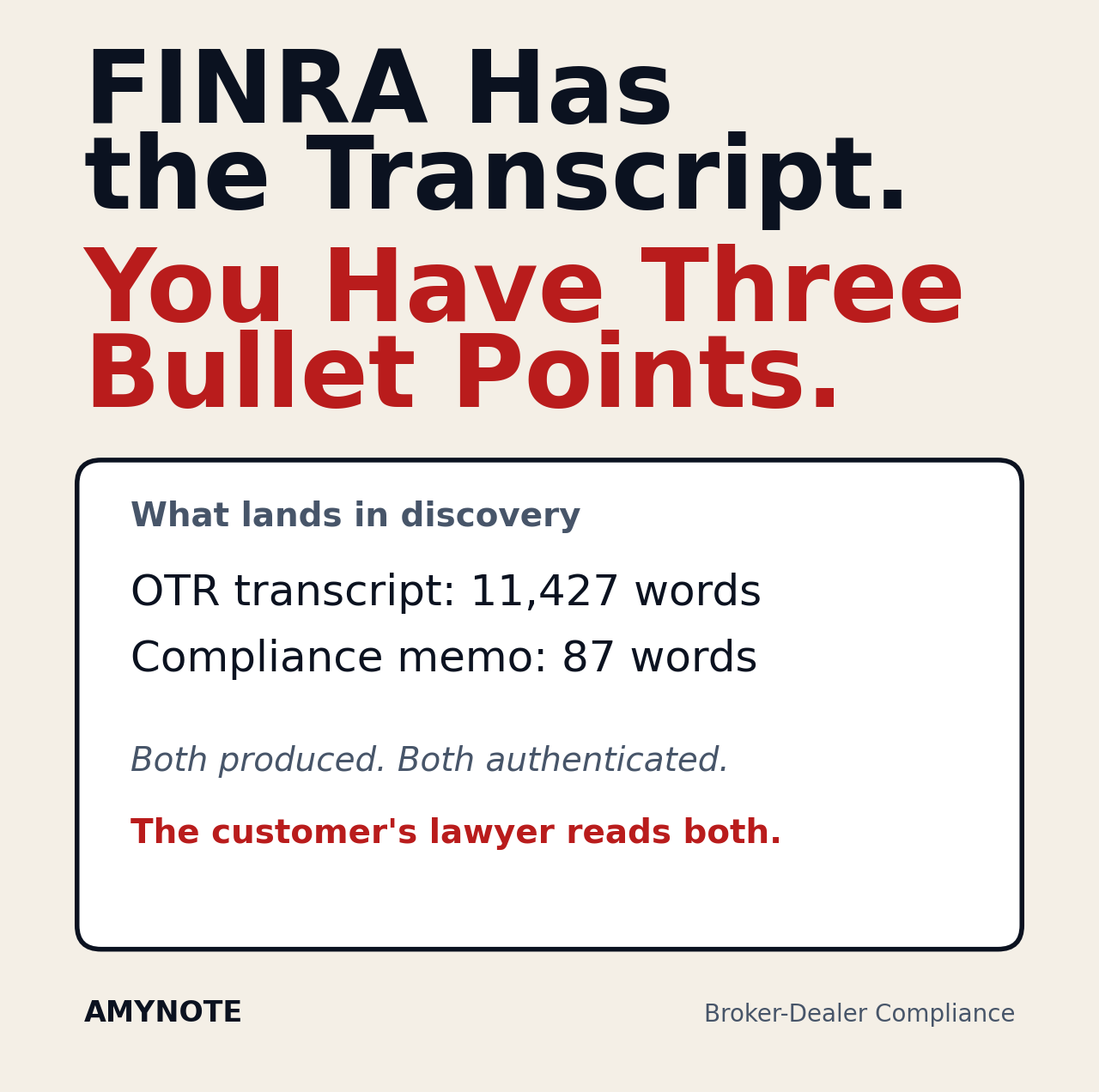
An on-the-record examination is the most expensive conversation a registered representative will ever have. A court reporter sits in the room and writes down every word. The questions can run for hours. The transcript becomes a permanent part of the FINRA enforcement record and a producible document the moment the customer arbitration is filed.
The conversation that happens around it — the prep session before, the debrief after — gets reduced to a memo. The memo summarizes. The transcript does not. That asymmetry is where good compliance documentation goes to die.
The Problem
A FINRA Rule 8210 request arrives. The registered representative sits down with the firm's in-house counsel, sometimes outside counsel, for a prep session that runs two to four hours. The lawyers take notes. Those notes become a prep memo to the file, usually four hundred words, sometimes fewer.
The OTR examination itself takes place at the FINRA District Office or by videoconference. A court reporter transcribes every question and every answer. The transcript is the official record. It often runs ten thousand to twelve thousand words.
After the OTR, the lawyers debrief the broker. More notes. Another summary memo. Maybe three hundred words.
Eighteen months later the customer files a FINRA DRS arbitration for unsuitable recommendations. Discovery hits. The transcript is producible. The prep memo and debrief memo, depending on the privilege analysis, often are too. Branch manager Rule 4530 intake notes from the original complaint are definitely producible.
Claimant's counsel reads all of it side by side.
Why Current Solutions Fail
The standard answer is "summarize the meeting, file the memo, move on." That worked when the only person who would ever read the memo was the next compliance officer assigned to the file.
That world is gone. The customer's attorney will get the OTR transcript, line up the prep memo next to it, and ask the broker on the stand to explain the discrepancies word by word. If the prep memo says "broker confirmed full disclosure of risk" and the OTR transcript shows the broker testified "I don't recall what I told the client about that specific risk," the memo becomes the impeachment exhibit, not the defense exhibit.
Privilege does not save you when the document was created to support a Wells submission, an AWC negotiation, or a public-facing supervisory record. The memo is going to be read.
The standard mitigations — longer memos, tighter templates, two lawyers in the prep room instead of one — do not solve the problem. They make the memo more defensible against a sloppy-drafting attack, but they do not close the verbatim-versus-summary gap. The court reporter is still going to produce a record that captures hesitations, walk-backs, and the specific phrasing the broker chose under pressure. The prep memo, however carefully written, will not.
How Customer Counsel Builds the Cross-Examination
When the arbitration starts, the claimant's lawyer does not have to do anything sophisticated. They do four things in sequence and let the documents do the rest of the work.
First, they pull the OTR transcript through the FINRA discovery process. Second, they request the firm's internal documents on the broker, including any prep memo, debrief memo, branch manager notes, and supervisory escalation records. Third, they build a side-by-side. Left column: what the broker said on the record. Right column: what the firm's documents claim the broker said, knew, or disclosed. Fourth, they walk the broker through every divergence at the hearing.
The divergences do not have to be lies. They almost never are. They are paraphrases that, eighteen months later, no longer match the words a court reporter wrote down. "Confirmed disclosure of concentration risk" in the memo. "I think we talked about how much was in tech, yeah, I'm pretty sure I mentioned it." in the transcript. Those are different sentences. The arbitration panel will treat them as different sentences.
What Actually Works
The protective approach is to make every interview record mirror the testimony, not summarize away from it. That means three things:
- Capture every prep session and every debrief at sentence-level fidelity. Verbatim or near-verbatim, with speaker attribution, timestamps, and the actual words used.
- Keep the verbatim record alongside the summary. The summary is for fast scanning. The verbatim record is what survives discovery.
- Treat the broker's exact phrasing as the source of truth. When the broker says "I don't specifically remember," do not paraphrase it as "the broker was unable to recall." Those are different sentences. Plaintiff's counsel knows the difference.
The economics matter here too. A court reporter for a one-hour prep session costs more than most firms will authorize for routine 8210 work. That is exactly why prep sessions have always been documented by memo and not by transcript. The cost of producing a verbatim record was simply too high to justify on the front end. The cost of not having one only surfaces on the back end, when an arbitration claim already exists.
That is the calculation an AI-assisted record changes. The marginal cost of capturing a prep session verbatim has dropped to near zero. The marginal value — a record that lines up with whatever FINRA's court reporter produces — has not.
Where AmyNote Fits
The mobile app runs on the lawyer's iPhone or iPad during the prep session. It captures the full audio offline, transcribes with speaker diarization so the record shows who said what, and delivers a searchable verbatim transcript alongside a structured summary. The transcript stays on device by default. Both OpenAI and Anthropic contractually guarantee zero training on user data. Audio is encrypted in transit; processing copies may be retained to deliver and recover requested features. Transcripts are stored locally on device with encrypted transport.
The result is a record that looks like the OTR transcript looks. Every word the broker said in the prep, ready to be compared against every word the broker said on the record. If there is a discrepancy, you find it before FINRA does and before claimant's counsel does.
The verbatim record also reshapes how prep sessions are run. Counsel can re-read exactly what the broker said about a specific account, in order, with the original phrasing intact, instead of relying on a paraphrased memo written by an associate who is no longer on the matter. That is useful before the OTR. It is decisive afterward.
Getting Started
Bring AmyNote to the next prep session. Run it in parallel with whatever note-taking your team does now. After the OTR, compare the verbatim prep transcript to the court reporter's transcript. The gaps will surprise you. The places where the broker's prep answer used different words than the OTR answer are the places you want to know about before the arbitration panel sees them.
The OTR transcript is going to exist. Your firm's memo is going to exist too. The only choice is whether they say the same thing.
Originally published as an X Article.