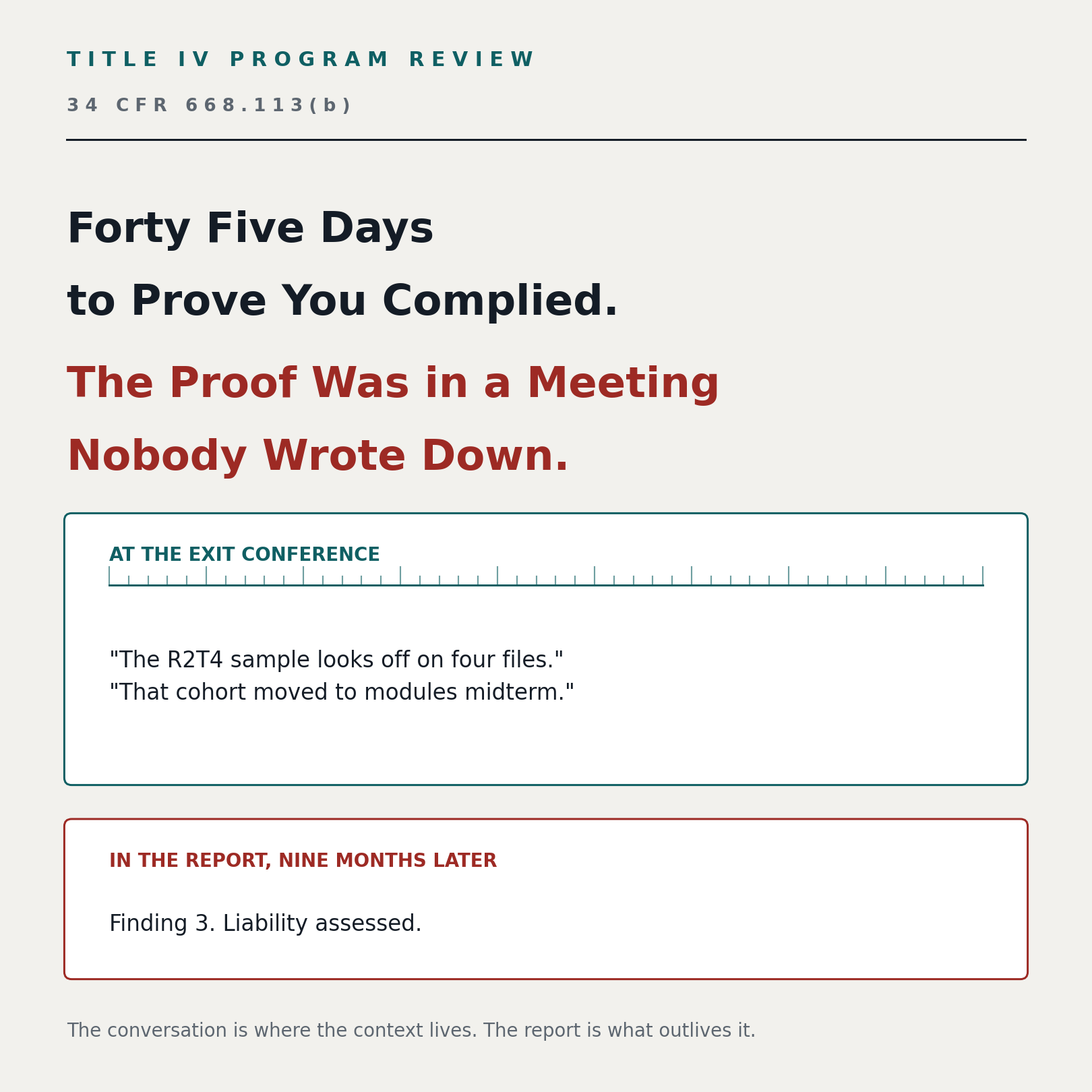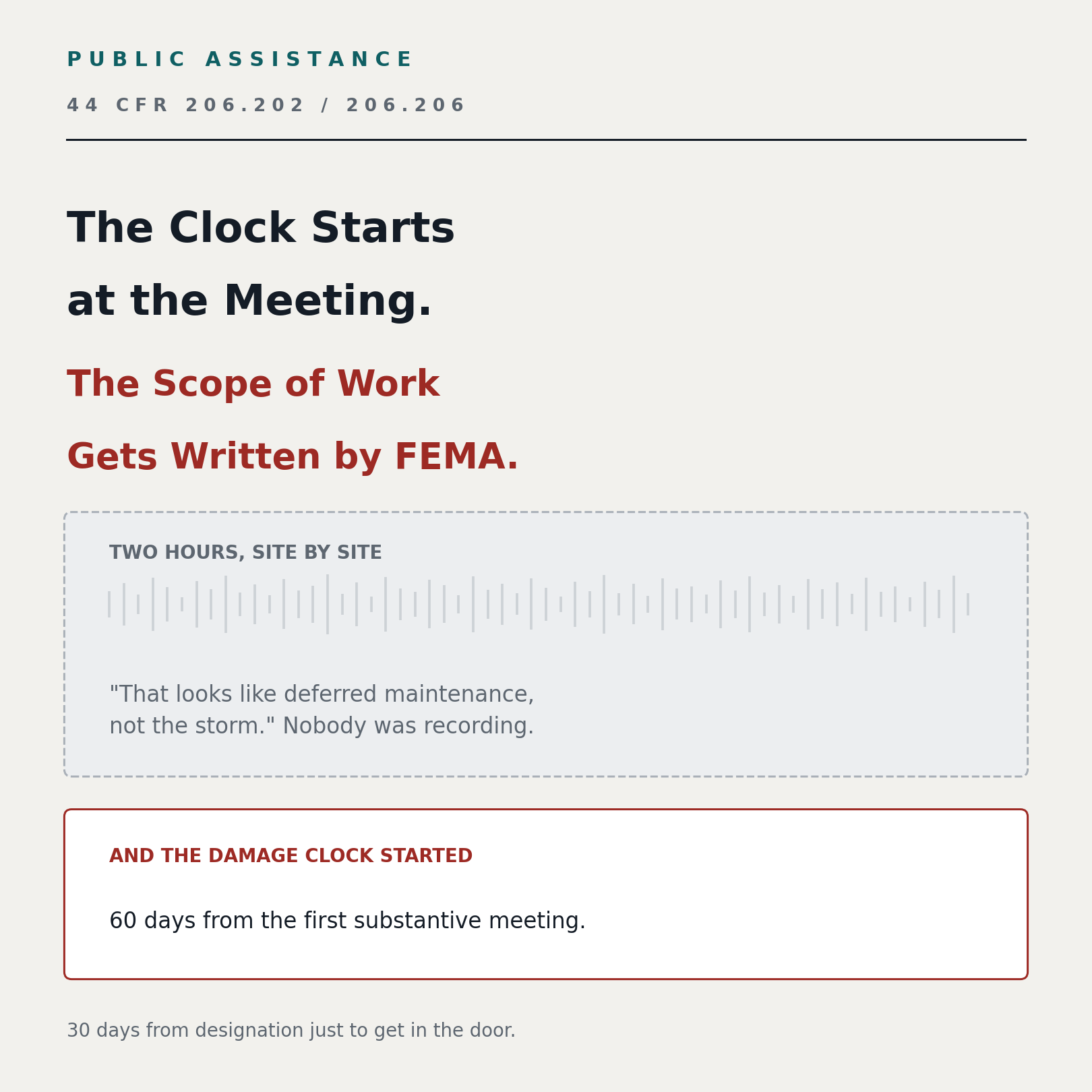
The meeting runs two hours in a borrowed conference room eleven days after the declaration. A FEMA program delivery manager walks the list site by site, and somewhere around the fourth one someone says the pump station damage looks like deferred maintenance rather than the storm.
Your public works director pushes back, the room moves on, and nobody writes down the exact words. Sixty days later the damage claim closes.
That is not a story about one badly run meeting. It is the predictable result of how 44 CFR Part 206 Subpart G is written.
The Meeting Is the Trigger
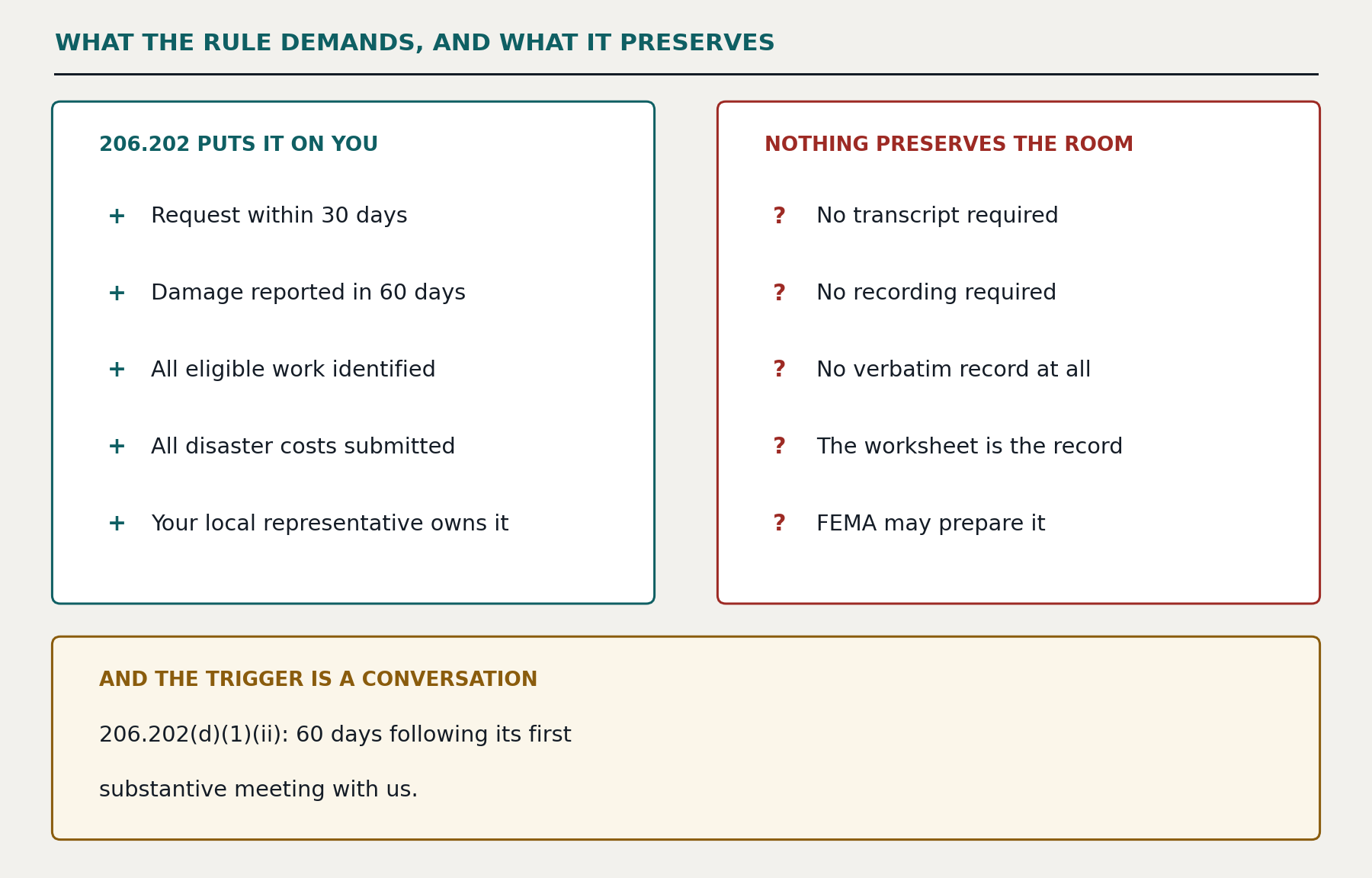
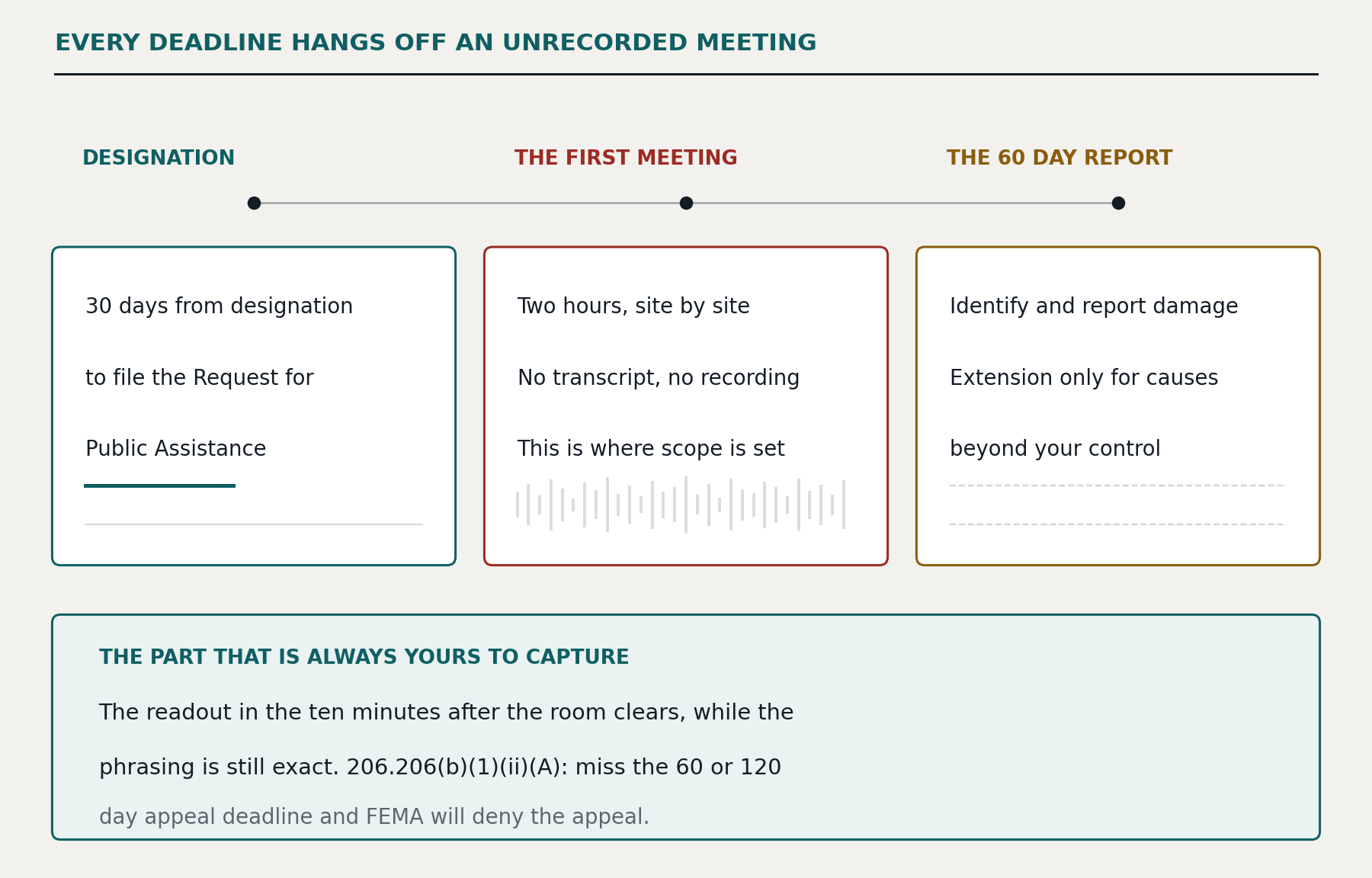
Under 44 CFR 206.202(d)(1)(ii) the rule is a single sentence. The applicant will have 60 days following its first substantive meeting with us to identify and to report damage to us.
Not 60 days from the declaration. Not from obligation of funds. From a meeting.
The front end is just as tight. Section 206.202(c) requires the Request for Public Assistance to reach the Regional Administrator within 30 days after designation of the area where the damage occurred.
And 206.202(d)(1) puts the burden on your side of the table. The applicant’s authorized local representative is responsible for ensuring that the applicant has identified all eligible work and submitted all costs for disaster-related damages for funding.
Read those together. A conversation starts the only clock that governs scope, the standard is every eligible site, and nothing in Part 206 requires anyone to make a record of the conversation.
It is worth being precise about what that does and does not mean. Nothing here is misconduct, and nothing suggests program delivery managers are withholding anything. A meeting held without a transcript is fully compliant with the regulation. The rule simply pairs a demanding substantive obligation — identify all eligible work, at every site, inside 60 days — with no preservation obligation at all, and so the richest account of what was discussed exists only as memory unless somebody decided in advance to keep it.
The Written Record Is a Worksheet Someone Else May Author
What survives the meeting is a Project Worksheet. Under 206.201(k) a project is a logical grouping of work, and the scope of work and cost estimate for a project are documented on a Project Worksheet (FEMA Form 90-91).
Section 206.201(k)(1) makes that document controlling. We must approve a scope of eligible work and an itemized cost estimate before funding a project.
Then 206.202(d)(1)(i) settles who holds the pen. We or the applicant, assisted by the State as appropriate, will prepare a Project Worksheet for each project. Often that is not you.
The consequence is structural rather than adversarial. Whoever drafts the worksheet is compressing a two-hour site-by-site discussion into a scope line and a cost estimate, and every compression is a judgment about what mattered. When the drafter is the agency, the judgment is theirs, and the document that results is the one everything downstream is measured against. Your recollection of the discussion is not a competing record. It is not a record at all.
Why the Usual Workarounds Fail
- Assuming you can buy more time. Section 206.202(f)(2) lets the Regional Administrator extend the 30 and 60 day limits, but only on a written request justified by extenuating circumstances beyond the recipient’s or subrecipient’s control. A site the team discussed and then forgot is not that.
- Planning to fix it on appeal. Under 206.206(b)(1)(ii)(A) a first appeal runs within 60 calendar days from the date of the FEMA determination, the recipient must forward it within 120, and if either deadline slips FEMA will deny the appeal.
- Expecting the appeal to weigh fairness. Section 206.206(b)(1)(i)(C) requires you to specify the provisions in Federal law, regulation, or policy the determination was inconsistent with. That is a documents argument, not a memory argument.
- Waiting for the overrun to surface it. Section 206.204(e)(1)(ii) lists change in the scope of eligible work as a standard overrun category, and permanent work carries an 18 month completion deadline under 206.204(c)(1). The scope conversation gets litigated long after anyone can quote it.
The last of those is the one that catches experienced applicants, because the failure surfaces so far from its cause. A scope disagreement that began as a sentence in a conference room in week two does not become a problem until a change in scope has to be justified against a worksheet written months earlier. By then the people who were in the room have rotated, the phrasing is gone, and the argument has to be made from documents that were never designed to carry it.
The appeal structure compounds this rather than relieving it. A first appeal is a written argument that a determination was inconsistent with law, regulation or policy — and 206.206(b)(1)(i)(C) says so directly. There is no provision under which a better recollection of the first substantive meeting becomes evidence. If the disagreement started as speech and stayed as speech, it does not enter the appeal at all.
What Actually Works
Treat the first substantive meeting as the record it legally functions as. Ask whether the session can be recorded, and capture your own side either way. A documented no is useful too — a written request that went unanswered is itself a dated document, which is a materially better position than a silence nobody can place in time.
Then hold the readout in the ten minutes after the room clears, while the phrasing is still exact, and build the damage list from that rather than reconstructing it on day 55. Nobody needs permission to keep an accurate account of a conversation their own team just had, and this is the one part of the process that is never at the agency’s discretion.
Memory does not degrade evenly, which is why the timing matters more than the effort. What survives a month is the gist — there was a disagreement about the pump station. What disappears first is exactly the detail that decides eligibility: which component, characterized how, on what basis, in answer to which question.
AmyNote captures it on the phone already sitting on the table. Transcription runs on OpenAI’s latest Speech API, which handles the vocabulary that breaks consumer tools: Project Worksheet, predisaster design, permanent work against emergency work, force account labor, hazard mitigation, obligation, small project validation.
Analysis runs on Anthropic’s Claude Opus, so you can ask the transcript what the delivery manager actually said about the pump station instead of replaying two hours of audio the week the clock runs out. Speaker identification separates the FEMA delivery manager, the State recipient staff, public works, and finance, and cross session memory carries the first meeting forward into every site inspection that follows.
On privacy: both OpenAI and Anthropic contractually guarantee zero training on user data. Audio is encrypted in transit and not retained after processing. Transcripts stay local on the device with end to end encryption. No damage inventory and no cost detail sitting on a third party server.
Getting Started
Write the capture step into the public assistance intake checklist now, before the next declaration starts a 30 day clock. The work of adding it takes an afternoon when nothing is happening and is effectively impossible in the eleven days between a declaration and a first substantive meeting.
Record every meeting with FEMA and with the State, hold a fifteen minute readout after each one, and build the 60 day damage report from a transcript instead of four sets of partial notes.
The regulation gives you the obligation and leaves the record to whoever holds the pen on the worksheet. The part it cannot take away is the account you were always free to keep yourself. AmyNote runs on the phone already in your pocket.
Originally published as an X Article by @AmyNoteApp.